

How to Extend the Life of Your Toyota Brakes
Last month, a Toyota Camry came in from South Euclid after its owner had been hearing a faint squealing sound during light braking for about two months. He had read online that brake squeal is sometimes normal and kept driving his daily route on Cedar Road and down Mayfield Road through Cleveland Heights without scheduling an inspection. By the time he came in, the brake pads had worn through their friction material on the inner passenger front corner, the rotor had been scored beyond resurfacing depth, and the caliper piston had begun to seize from the uneven loading. The brake inspection and pad replacement at the first sign of squealing? $280. The rotor replacement, new pads, and caliper service he needed two months later? $920.
That two-month delay between a recognizable symptom and a resolved service appointment is the most common version of a brake story we hear at Toyota Cleveland Heights every season. And it almost always costs significantly more than it needed to because brakes don’t stabilize on their own. They degrade, and the components downstream of the original problem pay the price while the driver waits to see if the noise goes away.
Greater Cleveland drivers face a brake environment that is genuinely more demanding than what Toyota’s general maintenance guidance anticipates. The combination of Northeast Ohio’s winter salt applications, the stop-and-go congestion on Mayfield Road, Cedar Road, and the I-271 corridor, the elevation changes on Cedar Hill and through the University Heights area, and the freeze-thaw cycle that stresses brake hardware repeatedly through January and February creates conditions that compress brake service intervals and accelerate wear in ways that a Cleveland Heights driver needs to understand to protect their investment.
The good news is that brake life is more within your control than most drivers realize. The habits, service timing, and awareness that extend brake life on a RAV4, Camry, Highlander, or Tacoma in Greater Cleveland differ from what works in a flat, moderate-climate market, and understanding those differences is what this guide is built around.
How Toyota Brakes Work and Where Wear Actually Happens
Most drivers think of brake wear as a simple consumption process: the pads rub against the rotors, friction material wears down, eventually the pads need replacement. That understanding is directionally correct but misses the factors that determine whether a set of brake pads lasts 25,000 miles or 55,000 miles on the same vehicle driven in the same city.
Your Toyota’s brake system converts kinetic energy into heat through friction between the brake pad and the rotor surface. The rate at which that conversion happens, and therefore the rate at which components wear, is determined by how often braking occurs, how hard the brakes are applied, how effectively the system dissipates the heat generated, and how well the mechanical components are maintained between service intervals.
In Greater Cleveland, all four of those factors are pushed in the direction of accelerated wear relative to a moderate driving environment. Traffic density on Mayfield Road and the I-271 approach ramps means more frequent braking events per mile than highway-dominated driving profiles. The salt and brine on Northeast Ohio roads through winter corrodes caliper slide pins and brake hardware in ways that cause uneven pad loading and asymmetric wear. The stop-and-go pattern of Cleveland Heights surface street driving generates more heat per mile than highway cruising. And the freeze-thaw cycle stresses the rubber boots and seals that keep caliper hardware functioning correctly.
The Caliper Slide Pin Factor
This is the component that most significantly separates brake systems that last from brake systems that wear prematurely, and it’s the one that Northeast Ohio salt exposure affects most directly. Caliper slide pins are the steel pins that allow the brake caliper to float and center itself on the rotor as the pads wear. When they’re properly lubricated and moving freely, both the inboard and outboard brake pads contact the rotor evenly and wear at the same rate.
When slide pins corrode from salt exposure and begin to bind, the caliper loses its ability to center. One pad stays in near-constant contact with the rotor while the other releases cleanly. The result is one pad that wears two to three times faster than its partner, a rotor that develops uneven surface heating patterns, and a braking system that produces less stopping force than its component condition would suggest. This failure pattern is responsible for a significant portion of the premature brake replacements our service team at the Mayfield Road location performs every spring.
Annual slide pin cleaning and lubrication, typically performed as part of a brake service, costs a fraction of the caliper replacement that a severely corroded slide pin eventually requires and meaningfully extends the service life of everything around it.
Driving Habits That Extend Brake Life on Cleveland Roads
The single most effective thing a Cleveland Heights Toyota driver can do to extend brake life has nothing to do with a service appointment. It’s a driving technique called engine braking, and it costs nothing to implement.
Engine braking means using your foot off the accelerator earlier and allowing the natural deceleration of the drivetrain to reduce vehicle speed before the brakes are needed to complete the stop. On the descent of Cedar Hill heading toward Little Italy, on the approach to the Mayfield Road and Taylor Road intersection, and on the downgrade sections of the I-271 exits into Cleveland Heights, applying engine braking before friction brakes converts less kinetic energy through heat in the brake components and extends pad and rotor life meaningfully over a full year of daily driving.
For RAV4 and Highlander hybrid owners, this principle operates through the regenerative braking system, which captures deceleration energy electrically rather than as heat in the friction brakes. Hybrid Toyota owners in Cleveland Heights already benefit from this automatically, but the habit of lifting off the accelerator earlier still matters because it maximizes the regenerative capture window before friction brakes are needed to complete the stop.
Following Distance as a Brake Preservation Strategy
Increased following distance is the other driving habit with the most direct impact on brake longevity, and it’s particularly relevant on the congested stretches of Mayfield Road and Cedar Road through Cleveland Heights and South Euclid where traffic density is high and stop events are frequent.
A driver following at three seconds rather than one second on a congested Mayfield Road commute allows significantly more time for traffic flow ahead to accelerate before a brake application is required. That additional time converts many brake events into lift-off decelerations that cost the brake system nothing. Over a year of daily Cleveland Heights commuting, the difference between one-second and three-second following distances can represent thousands of fewer brake applications on the same vehicle driving the same route.
A Tacoma owner from Lyndhurst came in last fall noting his brake pads had lasted only 22,000 miles on a set that the previous owner’s records suggested should have lasted closer to 40,000 miles. The driving history showed predominantly short-trip surface street driving through Cleveland Heights with a high frequency of hard stops. After a brake service and a conversation about following distance and engine braking habits, his next set of pads lasted 41,000 miles on the same routes. The brake service itself ran $480. The habit change cost nothing and saved him one complete brake service cycle over the following three years.
The Maintenance Practices That Protect Your Brake Investment
Driving habits extend brake life from the outside. Proper maintenance protects brake life from the inside, and in Northeast Ohio’s corrosive winter environment, the maintenance side of the equation matters more than it does in most other markets.
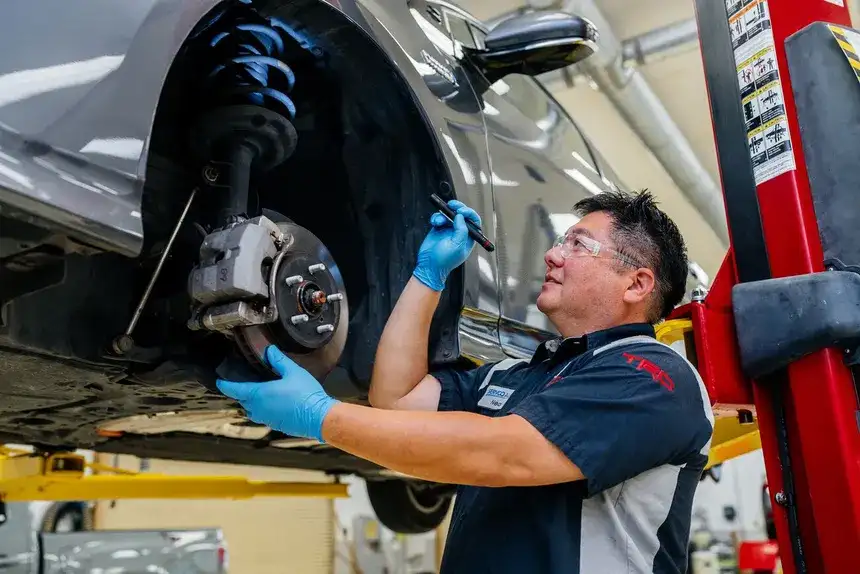
Annual brake inspections are the foundation. At Toyota Cleveland Heights, a brake inspection measures pad thickness on all four corners, assesses rotor condition for both remaining thickness and surface quality, evaluates caliper slide pin function, checks brake fluid moisture content, and visually inspects brake hoses and hardware for corrosion damage from winter salt exposure. This inspection either confirms your brake system is in good condition or surfaces a finding that costs significantly less to address when caught than when it’s left to develop.
Brake fluid service is the maintenance item most consistently skipped by Toyota owners who are otherwise conscientious about their vehicles. Brake fluid is hygroscopic, meaning it absorbs moisture from the atmosphere through the brake system’s rubber components over time. As moisture content rises, the fluid’s boiling point drops. In aggressive braking situations, the kind produced by the downgrade on Cedar Hill or by an emergency stop on rain-slicked Mayfield Road, brake fluid that has absorbed significant moisture can develop vapor bubbles that compress under pedal pressure and produce a sudden reduction in braking effectiveness.
Toyota recommends brake fluid replacement every three years regardless of mileage, and Northeast Ohio’s temperature cycling accelerates moisture absorption enough that the three-year interval is the appropriate benchmark rather than an overly conservative one. The fluid replacement service runs $89 to $110 and protects the hydraulic precision that your entire brake system depends on. 🔧
Cost comparison for maintaining brakes proactively versus reactively:
Proactive brake maintenance over 60,000 miles:
- Three annual brake inspections: complimentary with service visits
- Two brake fluid replacements at $100 each: $200
- One slide pin service and hardware replacement: $120
- Two pad replacements at correct wear limit: $560
- Smart proactive total: $880
Reactive brake maintenance over 60,000 miles:
- One premature rotor replacement from scored surface: $480
- One caliper replacement from seized slide pin: $380
- Emergency pad replacement after wear-through: $320
- Brake fluid replacement after vapor incident: $110
- Total reactive cost: $1,290
Your savings from proactive brake maintenance: $410 over 60,000 miles, plus the safety margin of a brake system that has never been allowed to degrade past the point where its performance was compromised.
“The drivers who get the longest life from their Toyota brakes in this area are consistent about two things: they come in for annual inspections and they don’t ignore the early warning signs,” says Patricia Kowalski, Lead Toyota Service Advisor at the Mayfield Road location. “Squealing, pulling, or a pulsation through the pedal are the brake system communicating early. Those symptoms at 3mm of pad life are a straightforward service. The same symptoms at 0mm of pad life with a scored rotor and a seized caliper are a completely different conversation, and it happens more than it should.”
Warning Signs Your Toyota Brakes Need Attention Now
Recognizing brake symptoms early is the highest-leverage skill a Cleveland Heights Toyota owner can develop, because the difference between an early symptom and a late symptom is consistently measured in hundreds of dollars.
Squealing during light to moderate braking is the most common early warning, produced by the wear indicator tab that Toyota engineers specifically into brake pads to alert drivers when friction material is approaching service limit. This sound is designed to be annoying enough to prompt action and quiet enough to be rationalized away. Act on it.
A grinding or metal-on-metal sound means the friction material is gone and the steel backing plate is contacting the rotor directly. This is a same-week service situation without exception, as every additional mile driven in this condition scores the rotor surface deeper and risks heat damage to the caliper.
Pulling to one side under braking indicates uneven pad contact from a binding slide pin or a caliper that isn’t releasing evenly, both of which are straightforward to address early and progressively more expensive to address after additional wear has occurred.
A pulsation or vibration through the brake pedal during moderate braking points to rotor thickness variation from thermal stress or surface corrosion that has developed over a Northeast Ohio winter. This symptom is often resurfacing-viable when caught early and replacement-required when left through another season.
A soft or spongy pedal that travels further than it used to before the brakes engage fully indicates elevated brake fluid moisture content or a hydraulic system concern that warrants prompt professional evaluation.
If any of these are present in your current driving experience, the service appointment should happen this week rather than at your next scheduled visit.
Your 30-Day Brake Health Plan
This week: Do a deliberate brake assessment on a familiar, low-traffic road. Accelerate to 30 mph and apply the brakes firmly but not to ABS activation. Note whether the pedal feels firm and progressive, whether the vehicle stops in a straight line, and whether you feel any pulsation through the pedal surface. Then drive slowly over a speed bump and listen for any clunking from the front suspension area that could indicate a brake or suspension component that has loosened from winter road stress. These two tests take less than five minutes and give you a useful baseline for your service conversation.
Within two weeks: Walk around your Toyota and look at the front rotors through the wheel spokes if your wheel design allows. A rotor in good condition has a consistent wear surface across the face without a pronounced ridge at the outer edge where the pad doesn’t reach. A visible ridge indicates meaningful rotor wear has occurred and the height of that ridge gives a rough indication of how much material has been consumed. Note the condition and mention it at your next service appointment.
By month’s end: Schedule an annual brake inspection at our Mayfield Road location, bundled with your next tire rotation if that service is due. Our Toyota-certified technicians will measure pad thickness on all four corners, assess rotor condition and remaining thickness, evaluate caliper slide pin function, and test brake fluid moisture content. The inspection is complimentary with your service visit and gives you a complete, accurate picture of your brake system’s current condition rather than a guess based on mileage alone.
These three steps take less than 30 minutes of your time outside the service appointment and create the awareness that allows brake maintenance to happen on your schedule rather than on the brake system’s schedule.
Toyota brakes are engineered for durability and reliability across a wide range of driving conditions. Northeast Ohio driving tests that engineering more aggressively than most environments, and the habits and service practices that respond to those conditions are what separate a brake system that delivers its designed service life from one that wears prematurely and expensively.
Schedule Your Brake Inspection Today
The South Euclid Camry owner from the opening came back six months after his repair and asked specifically what he should have done differently. He left with an annual inspection on his calendar every October, a clear understanding of the early warning signs, and a commitment to following distance habits that his technician discussed with him during the visit. His brakes have not surprised him since.
At Toyota Cleveland Heights, our certified technicians inspect and service brake systems on every Toyota model with the Northeast Ohio-specific experience that Greater Cleveland driving conditions require. Whether you’re hearing a noise, feeling something different through the pedal, or simply want the confidence of knowing exactly where your brake system stands heading into summer, we’ll give you an honest assessment and a clear recommendation.
Schedule your brake inspection today by contacting our service department or booking online. You’ll find us at 2950 Mayfield Rd, Cleveland Heights, OH 44118.
Proper brake maintenance protects your safety, extends the life of every component in the system, and ensures your Toyota stops the way it was engineered to stop on every Cleveland Heights road ahead. That is what consistent brake care delivers.
0 comment(s) so far on How to Extend the Life of Your Toyota Brakes